Showing posts with label Proteaceae - Persoonia. Show all posts

20 July 2013

Persoonia trinervis – Geebung

Click image to enlarge

Persoonia trinervis – Geebung

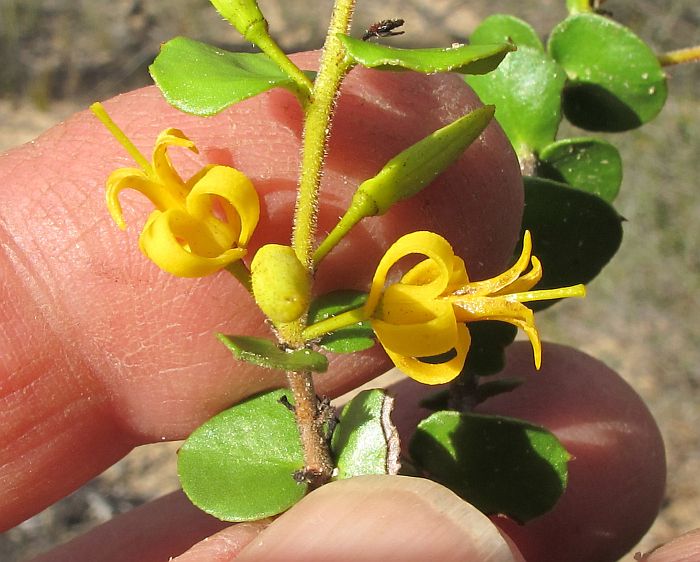
Persoonia trinervis is a highly variable species, especially regarding leaf shape. The plants photographed above are possibly from its most easterly colony, where common (although localised) at Lake Tay, 140 km (90 miles) NW of Esperance; here it grows in deep yellow sand possibly over gravel. It is a handsome bushy plant to a little over a metre (4’) in height with golden yellow flowers.

Its normal range is from Badgingarra (midway between Perth and Geraldton) and spreading in a broad band to the Lake King region 100 km (60 miles) west of Lake Tay. Despite its variability it is easy to identify, as it is the only species in its group to have a hairy ovary. Its group encompasses plants that have an appendage on top of the anther, which in this case although small of around 0.5 mm can be seen with a magnifying glass.

Many of these inland Persoonia spp. can be highly erratic regarding their flower time. Some plants will produce many flowers, whilst others growing next to it will not even have buds, yet may also bloom 2-3 months later. So finding flowers can be very much a hit or miss situation, but a month or two either side of the New Year, is worth checking inland Persoonia colonies as odd flowering plants are often encountered growing amongst a majority of unflowering ones.

At other times, the majority of plants can be found flowering madly, this from my observations would indicate certain climatic events must occur to stimulate flower and seed production. These plants produce a sizeable fleshy berry that demand favourable environmental conditions to successfully develop, so to take advantage of any passing summer storms, they would need a head start to produce seed successfully. Therefore by staggering flowering times could be a method of increasing their reproductive opportunities.

Flowering is recorded September to December, but the above were flowering during January and February, which may be explained by the spring period being drier than normal with some very hot days, but the following summer being mild with abnormally high rainfall.

The genus Persoonia is part of the very large, diverse and highly ornamental Proteaceae family.


13 November 2012

Persoonia spathulata – Geebung

Click image to enlarge

Persoonia spathulata – Geebung

This species has a rare Conservation Code rating of Priority Two, which basically means it is only known from a few locations, but is not thought to be in any immediate danger. It occurs NW of Mt. Ridley (north of Esperance), Cape Le Grand and Israelite Bay (east of Esperance) and had not been collected since Robert Brown’s Cape Le Grand collection in 1802 until 1979, when found at Israelite Bay by E.B. Barnsley. It has only been collected from two other localities since.

A very similar species Persoonia scabra whose distribution overlaps Persoonia spathulata is far more common, but is also poorly known with a rare Conservation Code rating of Priority Three, which means this species is known from a number of localities, but only in small numbers. The easiest way to distinguish the difference between these plants, is P. spathulata has both glandular and non-glandular hairs on leaves and flowers, whereas P. scabra has only non-glandular hairs that are soon deciduous thereby becoming glabrous (without hairs).

There are a number of other differences between these species, some detailed in my P. scabra post, with others difficult to describe in this format. Because of the subtle differences and combined with a small number of collections, these species have been lumped together and were only separated by Dr Peter Weston in his revision of the Western Australian Persoonia species in 1994 (Telopea 6 (1): 51-165), when better quality material became available.

There are two colonies of Persoonia spathulata that I am aware, both in the Crystal Lake region NW of Mt. Ridley, which consist of a number of individuals that make up defined colonies (P. scabra tends to occur as scattered individuals or in small groups). The P. spathulata colonies known to me are sited on the sides of large (not steep) sand-hills (P. scabra tends to grow on sandy flats); both species are confined to heath habitats.

Persoonia spathulata has a more upright growth habit than P. scabra and grows to around 60 cm (2’) in height; the young foliage is coarsely hairy and the hairs hatchet shaped with the handle held above, but parallel to the leaf surface. The deep yellow flowers are produced between December and January, but like many dry-land Persoonia spp. their occurrence can be very erratic.

The Persoonia genus is part of the impressively diverse Proteaceae family.


Persoonia scabra – Geebung

Click image to enlarge

Persoonia scabra – Geebung

Plants in the genus Persoonia are collectively known as Geebungs, which is usually placed after the plant description, like scabra refers to the sandpaper-like texture of the leaves, so this species could rightfully be called Sandpaper-leaved Geebung. Although in WA, possibly due to their obscurity, very few have been given common names.

Persoonia scabra is quite widespread, from coastal areas to the inland mallee region, usually growing in a sandy  heathland environment, often overlying gravel, granite or limestone. Although I regularly encounter this shrub, there are rarely more than a handful of individuals, so it is not something to go looking for, as you are most unlikely to find it, but to keep it in mind if you happen to stumble upon one.

This species is usually no more than ½ metre (18”) in height, with an untidy spreading habit, it was confused for many years with Persoonia spathulata that overlaps in distribution, but is much less common and has a more upright habit. The leaves of both species are similar in size and touch, but with P. scabra the leaves are asymmetric and leaning, with P. spathulata they tend to be symmetrical and upright. It is the flowers however that differ most, with P. scabra having no, or few non-glandular hairs on the outside of the flower and a flower stalk (pedicel) with no hairs, whilst P. spathulata flowers are glandular hairy on the outside as are the pedicels.

Locating Persoonia scabra and several other species when in flower can be very frustrating, as some seem to miss a flowering season altogether, whilst others flower early, but their neighbours flower late. Generally they are slow growing plants, doing very little in the way of growth for several years, seemingly waiting for a bushfire or conditions to change before putting on a spurt of growth, or regrowth from the rootstock. Flowering, depending on seasonal weather conditions, which is another factor influencing the time they bloom, is usually from November to January.

10 May 2011

Persoonia helix – Spiral-leaved Geebung

Click image to enlarge

Persoonia helix – Spiral-leaved Geebung

It is not unusual for Persoonia plants to have a twist in their leaves, but P. helix is the most pronounced with up to 3 complete revolutions, although with some plants the leaves have fewer turns. The Spiral-leaf Geebung is an inland species from 50-400 km (30-250 miles) from the coast and is found from the NNW of Esperance to the Ravensthorpe district, then north to the Coolgardie region (west of Kalgoorlie). It is a moderately bushy shrub to around 2.5 metres (8’), but in the Esperance region it seldom exceeds 1.5 metres (5’).

Persoonia helix grows in mallee heath and is widespread in the Rollonds/West Point Roads district NW of Esperance, usually in scattered small colonies growing in deepish sandy soils over granite or gravel. The twisted leaves have a vertical growth and are grey/green, leathery and tough, but not sharply pointed. The bright yellow flowers can be highly fickle as to when they appear, probably being more reliable in years of regular rainfall which is seldom the case where they occur, but they are recorded in bloom from November to February.

Pollination of many Persoonias is from various species of native bee, which land on the flower and force their way down between the style and anthers (in this case, the upper recurved portion of the flower) to the nectaries at the base of the flower. As native bee species are not common in coastal areas around Esperance, this may help explain why most local Persoonias are more common inland.

06 May 2011

Persoonia dillwynioides - Fitzgerald Persoonia

Click image to enlarge

Persoonia dillwynioides - Fitzgerald Persoonia


As the common name suggests, this species is mainly found in and around the Fitzgerald National Park to the south and southwest of Ravensthorpe, which is 175 km (110 miles) west of Esperance. It is also a near coastal species occurring within 50 km (30 miles) of the coast, where it grows into a bushy shrub of over 2 metres (7’-8’) in height. The photographed plant above represents a range extension, occurring around 45 km east of Ravensthorpe and a similar distance from the coast.

The Fitzgerald Persoonia above was growing in an open woodland in a sandy heath, with only a handful of widely spaced plants either side of the Oldfield River. Elsewhere it is recorded from gravel, clay and a stony loam, so obviously is quite adaptable to non-calcareous soils. Persoonia dillwynioides is similar in general appearance to Persoonia cymbifolia as both have slender concaved leaves although the former to 2 cm (3/4”) and up to twice that length with the latter. Persoonia cymbifolia also differs by being more of an inland species of over 50 km (30 miles) from the coast, and usually less than a metre (3’) in height.

The flowering period of Persoonia dillwynioides is recorded from November to January, but like many Persoonia spp. in these drier environments can be highly variable, even between neighbouring plants with one blooming early and the other late, so often repeated visits are required before they are caught in full flower.

My thanks to Dr Peter Weston for the identification of this species.


23 December 2010

Persoonia striata – Proteaceae

Click image to enlarge

Persoonia striata – Proteaceae

Most people know some genera within the Proteaceae family like Banksia, Hakea, Grevillea, ets., plus the spectacular South African Protea, but except for a few keen native plant enthusiasts, the Persoonia genus is poorly known even amongst Australians despite there being close to 100 endemic species. They are tough plants usually with thick, rough to touch foliage (rarely prickly) and generally occur in scattered small colonies, which probably represents their method of seed dispersal.

Persoonia seed have a fleshy exterior, much favoured by animals particularly emus who after eating will as they move around, pass the hard internal seed via their droppings, hence colonies formed this way are often small and scattered. Seed dispersal by smaller animals possibly bushrats or the larger skinks like Bobtails, Blue-tongues and Erernias who are very fond of this type of vegetation, could result in larger Persoonia colonies. Persoonia striata plants can also give the impression of being part of a larger colony as they commonly produce aerial stems  that arise from the underground rhizome, or spreading root-system (see first photo above).

Normally, this Persoonia species would not be found in my definition of the Esperance district, but I located a colony right on the boundary where West Point Road crosses the Oldfield River, which is roughly 50 km (30 miles) east of Ravensthorpe. Here several plants grow in a coarse sandy loam, just above the river, which I might add is quite saline, although in this area is mainly sub-surface when not in flood.

Persoonia striata is a low spreading shrub of around 60 cm (2’) in height, with yellow flowers that bloom from October to December. There are other similar low growing Persoonia species that are more common in the Esperance region, but P. striata is restricted to over 100 km (60 miles) west of Esperance, plus the leaves are flat and have three distinct longitudinal ridges on both surfaces (see photos).

20 December 2010

Persoonia cordifolia – Heart-leaf Persoonia

Click image to enlarge

Persoonia cordifolia – Heart-leaf Persoonia

Persoonia is a member of the large and often spectacular Proteaceae family. They are unusual within this family for producing a seed enclosed by a soft edible fleshy layer (drupe), like a cherry it is intended to encourage animals like birds and mammals to eat them, so spreading the seed via their droppings. Most other Proteaceae produce a dry capsule, which upon opening rely on the wind to disperse the seed.

There are close to 100 Persoonia species and all but two are endemic to Australia, in Western Australia there are 43 species mostly in the southern portion of the State. Persoonia cordifolia is only found in a small area approximately 130 km (80 miles) NE of Esperance. Here it grows in a deep sandy loam, which is a minor habitat in the mallee region, where typically the soils comprise a fine sand/clay over limestone. The sandy areas occur as islands, sometimes with a sandy isthmus joining a few together. In most of the mallee, these sandy patches would make up less than 10% of the total area, but in this district it is much higher to possibly over 20%.

Persoonia cordifolia is very sparsely distributed within these sandy areas, even when habitat seems suitable. The highest populated area I have encountered is around a small to medium saltlake over 40 km (25 miles) NE of Mt. Heywood, where over several kilometres only 20 odd plants were found, mostly in ones and twos, rarely more. They were to a reasonably uniform height of around 1 metre (3’), probably due to new growth after a fire, which swept through about 5 or so years ago. Interestingly, only one plant was producing flowers (the smallest), with no sign on the others.

The only other known group of Persoonia cordifolia is 8-10 km (6 miles) to the SE of the above saltlake, where there are less than 10 plants spread over 4 km (2.5 miles). Plants in this area are in much older growth vegetation and range in height between 1-3 metres (3’-10’) and most had flowers. I am reasonably familiar with this scattered group going back 20 years when I first discovered them and I am quite certain that the largest plant and its companion 50 metre/yards away are the same individuals. When originally encountered one was around 2 metres (6’-7’) in height and the other about a metre (3’). Now the taller one has grown a metre (3’) and the smaller 1/2 metre, so not exactly a fast growing species, even considering the low rainfall of the region.

There would have to be more of these plants in the district, but it is difficult country to penetrate and to my knowledge no plant, let alone new colony has been located. So due to its sparse distribution in a very localised area, slow growth and strange flowering habit, you would think it would have a high conservation status, but alas it has none, which I think must be an oversight and I hope the situation will soon be corrected as mining exploration is ongoing in this district.

According to Dr P. Weston in his paper ‘The Western Australian species of subtribe Persooniinae (Proteaceae: Persoonioideae: Persoonieae), where Persoonia cordifolia is described, he made particular mention that this ‘is a distinctive species, not resembling any others.’ Flowering is known only during December and January, but due to the large number of individuals not currently in bloom, there may be different conditions or another period that will influence when they flower.

12 February 2009

Persoonia teretifolia

Click image to enlarge

Persoonia teretifolia

An open shrub growing to 1-2 metres (from 3' to around 6') in height, with a habitat preference for heavy clay type soils with a shallow sandy overlay. It is particularly common in the mallee region, where these conditions occur in a wide arc to the north of Esperance.

Persoonia teretifolia is distinguished from other Persoonia species by the long terete (rounded and without any grooves) leaves, plus a swelling on one side of the floral tube. Despite the open habit of this plant, it presents a good floral display of bright yellow flowers that are not hidden by foliage. The no less attractive blue/green leaves are held in a near vertical position. Flowering can be variable due to irregular rainfall, but the main period in this region is between October and February.