Showing posts with label Haemodoraceae - Haemodorum. Show all posts

26 March 2012

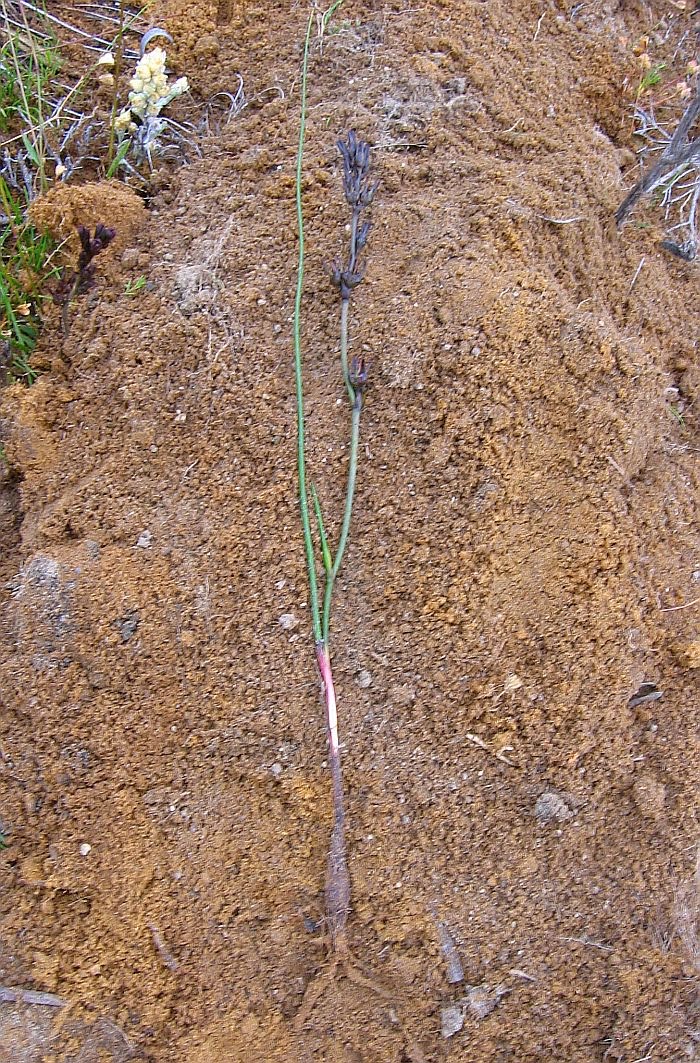
Haemodorum discolor – Bloodroot

Click image to enlarge

Haemodorum discolor – Bloodroot

Plants in the Haemodorum genus are related to Kangaroo Paws (Anigozanthos) in the Haemodoraceae family, but are much stranger. Like Kangaroo Paws they produce vertical flowering stems, but instead of brightly coloured tubular flowers, theirs are uniformly dark brown or black and unless you look closely are more like unopened buds. Haemodorum species also grow from a red or orange bulb, which are quite spicy and were used by aborigines as a food source.

In the Esperance region, there are 4 known species, of which this species and H. laxum are only known from a couple of collections. Both these species favour good sandy loams over gravel, which of course are the same as favoured by farming communities, so many colonies in this district have probably been cleared for that purpose. Other colonies may exist, but they are very difficult to find, as they mainly flower after bushfires, leaving only sedge-like leaves showing at other times. So to locate them, you must be in the right place at the right time, which could be a decade or more apart.

Haemodorum discolor is very similar to H. laxum, which although common elsewhere is locally only known from a single collection west of Esperance. To separate these species, the bracts of H. discolor are fleshy with broad white margins, whilst H. laxum are not fleshy and have narrow pale brown or grey margins.

The two common local Haemodorum species (H. brevisepalum and H. spicatum, details ) are unlikely to be confused with Haemodorum discolor, as they both have rounded leaves in cross section, whilst H. discolor has thick flat ones. The flowering stems to 1 metre (3’) are also branched to produce numerous loose clusters of flowers that bloom between September and November.

Currently the only known colony of this plant is at the base of a large granite outcrop east of Esperance. They are however quite common SW of a line between Kalbarri and Ravensthorpe, with odd records around Southern Cross.


27 May 2010

Haemodorum brevisepalum – Short Sepal Bloodroot

Click image to enlarge

Haemodorum brevisepalum – Short Sepal Bloodroot

Haemodorum brevisepalum is in the Haemodoraceae family, the same as Kangaroo Paws (Anigozanthos), Conostylis and others, but bears little resemblance to them. The flowers plus most other parts, are very darkly coloured with no colourful display as normally expected from this family, the exception being the bulb type root that is orange/red when sliced and used by aborigines as a spicy food source. The one excavated above was collected for the WA Herbarium.

Purely going on photographs of this species and Haemodorum spicatum (previously posted, see species list in right-hand column), both look very similar, but in the field are easily separated by their height difference. H. spicatum is commonly over a metre (3’) in height, whereas the Short Sepal Bloodroot seldom exceeds 30 cm (12”). The other difference is in the length of the outer perianth segments (sepals) that are much shorter with H. brevisepalum (half the length of the inner perianth ‘petals’). With H. spicatum, the mature sepals and petals are much the same length.

An explanation of the floral structure will help understand the transformation detail in the above photographs. Taking the top two photos, it will be noticed that the flowers are in pairs and when fruiting, the triple seed capsules represent a single flower. The pink coloration at the flower summit are the tops of broad anthers and are not an inner petal, the outer black/brown portion is the petal, but the anther is supported by a thick filament that is attached to the inner base of the petal. The smaller looking petals further down and between the long petals are actually the sepals.

The distinctions between the above features are now more clearly seen in the top right picture, showing the seed capsules and dried floral parts. The anthers are clearly seen atop the three taller spike-like projections and if you look closely, the filament below the anther is actually wrapped in the dried shrivelled petal. The sepals as they matured have increased in width and are the broad bract-like components with a spiked apex, which  are formed by greater shrinkage at the unattached sepal top as it dried.

Although poorly collected, Haemodorum brevisepalum is actually common (if not localised) in moist heath to the east of Esperance. This is because it mainly shows itself the following spring/summer after a bushfire, when it can occur in colonies of 10 or more plants per square metre/yard and spread over several hundred square metres/yards. During the hotter summer months they die back to ground level, but the seed from this post fire period will germinate after autumn rains, but do not flower. The following spring/summer a small portion of the mature plants (no young ones) will flower, with something like a single plant to 10 square metres/yards or even fewer. In following years their flowering numbers will decrease even further once surrounding vegetation develops to crowd them out, also I have not seen any leaves of non-flowering plants despite hands and knees searches over known sites.

This species prefers a heavier loam than the larger Haemodorum spicatum, which is commonly found in deep sandy soil. Locally Haemodorum brevisepalum is found on near coastal flood plains in a sandy/peat soil over clay that is approximately 30-45 cm (12”-18”) below the surface. Also in a sand/clay loam of similar soil depth over granite, or gravel at the base of granite outcrops. Both habitats would provide moist, but slow draining conditions (akin to deep level seepage). Flowering is recorded from September to December, but the fruiting plant can be found until March, when the now dead and dried (above ground) vegetation will start breaking down.

31 December 2009

Haemodorum spicatum – Bloodroot

Click image to enlarge

Haemodorum spicatum – Bloodroot

The Bloodroots (Haemodorum) are related to the Kangaroo Paws (Anigozanthos), both belonging to the family Haemodoraceae, but apart from the long annual flowering stem, they are otherwise very different. They are called bloodroots due to the color of the red bulbous root, which was commonly eaten by aborigines and is apparently quite spicy. I should add (like all wildflowers) they are protected these days and one was only dug-up to provide a specimen for the Perth Herbarium, who require the leaf connection to the rootstock, which necessitated collecting the entire plant.

There are three known Haemodorum species in the Esperance region, which in appearance are quite different from each other, plus they grow in different soils. Haemodorum spicatum would be the most widespread, occurring in light sandy soils, from low-lying flats to the tops of hills. Although in suitable habitat a common species, locally they do not form dense colonies, but grow as scattered individuals or in small groups.


Haemodorum spicatum each year usually produces 2-3 round (terete) tough green leaves (around 60 cm or 2’ in length), which remain alive and exposed for several years to form a loose rosette of lax different aged foliage. In most years, a single flower spike (rarely two) forms and can grow to over a metre (4’) in height. These and the flowers are coloured dark brown to black with the floral part occupying the upper half and several black pointed leaves the lower.


The flowers mature from the bottom up, so seed is invariably forming at the floral base, whilst flowers near the top have yet to bloom. I have never seen a bird visit these plants, so presumably they are insect pollinated. The flowers are certainly not what you would call attractive, although bloodroots are very interesting plants and structurally appealing, plus there is nothing else looking remotely like them. They thrive in fire prone areas and all produce flowering spikes after one, which being a metre in height, tower over other regenerating vegetation. Flowering is recorded from October to January.