Showing posts with label Boraginaceae - Halgania. Show all posts

24 January 2012

Halgania anagalloides – Blue Bush

Click image to enlarge

Halgania anagalloides – Blue Bush

This Halgania species is either a low spreading shrub, or a procumbent one and is widespread on a variety of non-calcareous soils in the drier regions from Israelite Bay to Kalbarri, with most collections away from the coast, but still within the wheatbelt zone. Currently there is confusion regarding the classification of this species, as not so long ago it was split into two varieties (var. anagalloides and var. preissiana), but these were discarded to lump them all into Halgania anagalloides. However, a new variety (var. Southern) has now been generated, but is not currently recognised, so currently all these plants are still officially grouped into Halgania anagalloides, but there is very likely to be another split somewhere down the line.

Plants contained within Halgania anagalloides, have toothed leaves of which they and the stems are covered in appressed stout white hairs, but no glandular ones (if plants have silky or glandular hairs, they belong to a different species). After a bushfire these plants usually respond very well and their number can increase considerably, but after a few years most are overgrown by larger bushy shrubs. Therefore in the long term, survivors tend to be restricted to natural openings, or in the dappled sunlight under mallee eucalypts that dominate the moisture, so making it too dry for large shrubs. Flowers can usually be found anytime during the warmer part of the year, particularly after good rainfall, although they seldom flower during the colder winter months.

Halgania is part of the Boraginaceae family.


21 January 2012

Halgania sp. Peak Eleanora – Boraginaceae

Click image to enlarge
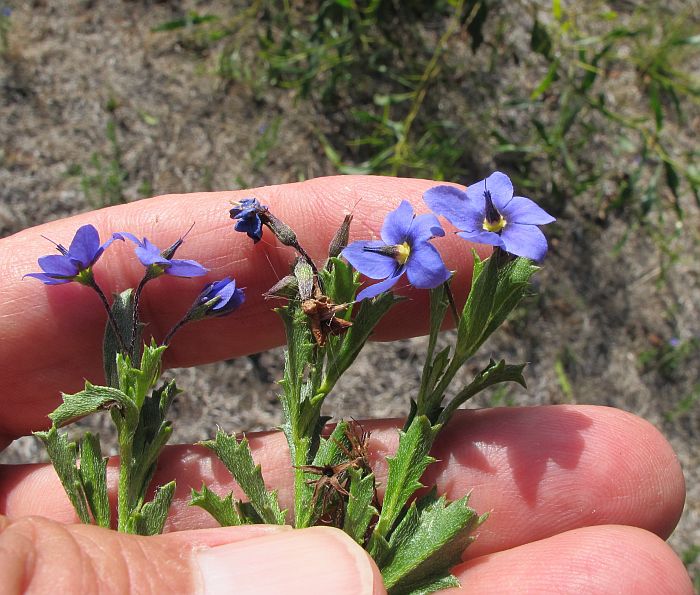
Halgania sp. Peak Eleanora – Boraginaceae

The above is a small rare Blue Bush species that is only known from a handful of collections in the Peak Eleanora region, which is 8.5 km (5 miles) south of Peak Charles and 120 km (75 miles) NW of Esperance. The above were photographed 15 km (9 miles) south of Peak Eleanora, growing in a slight hollow after a fire, and a sandy/clay loam over limestone.

Halgania sp. Peak Eleanora has a Priority Two conservation code, which basically means it is only known from a few collections and is currently not under any immediate threat. The single colony I happened upon had around a dozen plants and was very localised. The plants were of various sizes to 60 cm (2’) in height and the foliage was a very dark green and quite viscid (sticky), leaves were strongly recurved, some to 180 degrees. The partly hidden flowers were small, deep blue and semi-pendant.

Flowering time is not recorded, but from my observations over two seasons, they were in flower from early September to mid October, so reasonably safe to predict that in a normal year, they would at least span from August to November.

Update September 2012
Around 185 km (115 miles) due east of Peak Eleanora and near a large rocky outcrop, this species occurs in their thousands.  Plus around 5 km SW of that colony, there is another where this species would be in their millions.  Both colonies were growing in a heavy sandy loam (possibly overlying limestone) in a mallee eucalypt woodland that had been burnt 3-4 years earlier.  The habitat was noticeably flat and in a non-flooding low lying area.   There is no development in this region and similar habitat is reasonable common, therefore this species would not be considered rare or endangered.


18 January 2012

Halgania lavandulacea – Blue Bush

Click image to enlarge

Halgania lavandulacea – Blue Bush


These attractive blue flowered shrubs belong to the Boraginaceae family and are widely distributed in Western Australia. Halgania lavandulacea mainly occurs from the NW of Esperance to Ravensthorpe, then both converging NW to Morawa, with a few outlying records from the Israelite Bay region and between Norseman and Kalgoorlie. It is not common around Esperance, with scattered small colonies in mallee regions from south of Mt Ridley to the southwest of Peak Charles (100 NW of Esperance), after which it becomes increasingly more common.


Most of my sightings have been on the edge of burnt areas in sandy loams and/or gravel over limestone. Shrubs have been to a metre (3’) in height and quite bushy. The blue flowers can usually be found at most times of the year, especially after summer storms, but the main period is late winter and through spring. The foliage is soft and not sticky, unlike the viscid H. andromedifolia (listed in the right-hand column), although these species have in the past been linked together. Besides not having sticky foliage, the calyx lobes of Halgania lavandulacea are of equal size (H. andromedifolia are unequal), plus most H. lavandulacea flowers are arranged singularly in the upper leaf axils, whilst most H. andromedifolia flower stalks (pedicels) are branched.


14 June 2010

Halgania andromedifolia - Blue Bush

Click image to enlarge

Halgania andromedifolia - Blue Bush


Halgania andromedifolia is a reasonably common and widespread shrub, particularly of the mallee region that typically has a fine sand/clay topsoil over limestone, although it can also be found on gravel and over granite, although the latter usually has a limestone overlay. It does very well after bushfires that reduces competition from other plants, especially overhead eucalypts that dominate available moisture and sunlight in a low rainfall district.

Shrubs in the Halgania genus are generally known as Blue Bushes as most have deep blue flowers, although purple, pale blue and even white forms are not unknown. The 1.5 cm (½”) diameter flowers of Halgania andromedifolia are almost a royal blue and as they grow in terminal clusters can be very showy. The leaves are a shiny bright green and quite viscid (sticky), which provides a gloss.

There are 14 West Australian Halgania species, with 4 being recorded for the Esperance region, most occur inland and only one is commonly found near the coast. It is interesting to note that hardly any collections have been made SW of a line drawn between Albany and Perth, where conditions during winter are colder/wetter and although containing coastal heath, is otherwise heavily forested.

Halgania andromedifolia grows mostly from ½ to 1 metre in height, slightly wider than high and usually bushy from the ground up. Flowers are recorded from August to January, but this would depend on seasonal rainfall, which can be quite variable in these drier areas. Flying insects (due to the sticky foliage), I imagine would be the main pollinators.