Showing posts with label Fabaceae - Acacia. Show all posts

21 April 2015

Acacia acanthoclada subsp. acanthoclada - Harrow Wattle

Click image to enlarge

Acacia acanthoclada subsp. acanthoclada - Harrow Wattle

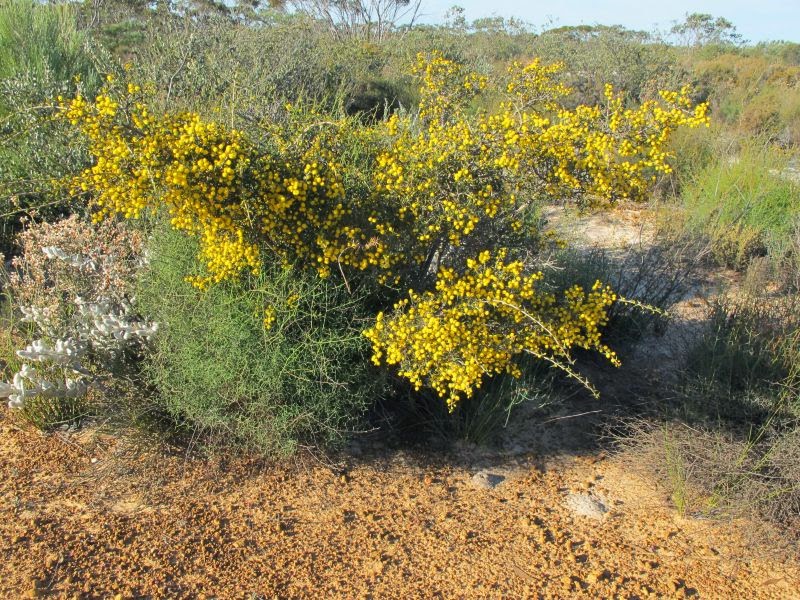
Acacia acanthoclada is named after its spiky tipped branches (A acantha: thorn + clad: branch), of which it is very fitting. On the habitat photo above, this plant extended 300-400 metres/yards to the rock getting denser as one progressed, so much so that I had to carry the dog in places, whilst I battled on in my shorts with scratched and bleeding legs.

Most Acacias love bushfires and can germinate in vast numbers in their ashes, as was the case above, but fortunately the aptly named Harrow Wattle was only around ½ metre/yard in height at the time I was there. However if I visited a year or two later, they would be 1-2 metres (5’) in height and be impossible to pass through.

This well armed species prefers the semi-arid inland, which in its WA distribution, extends from around 50 km (30 miles) from the coast, to near Wiluna, approximately 870 km (540 miles) NNW of Esperance. It also occurs across the Eyre Peninsula in SA and to the intersecting boarders of SA, NSW and Victoria.

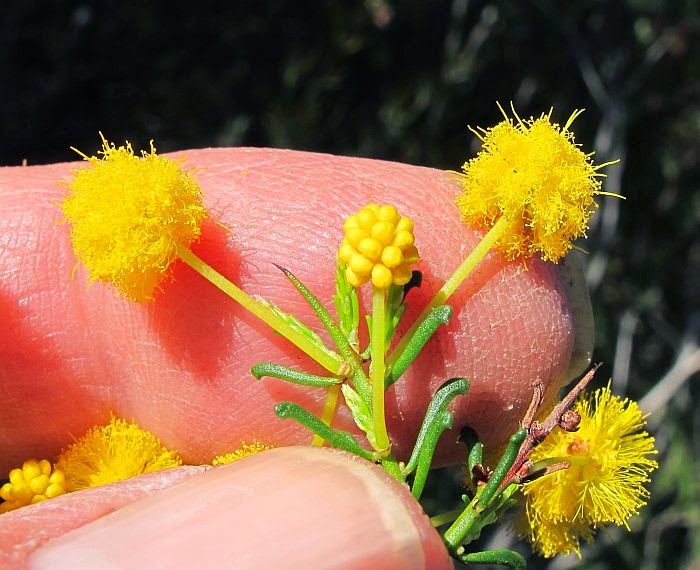
Despite the prickly nature of Acacia acanthoclada, it has attractive golden yellow flowers and is very colourful in the bush, although most gardeners have great distain for these plants, but their dislike is very misplaced. The advantage of prickly Acacia shrubs is they provide a fast growing impenetrable hedge, plus a marvellous place for little birds (under their protection) to hunt for grubs and to nest.

Acacia acanthoclada is recorded flowering from July to December; it has two subspecies, of which the above is the most widespread, the other subsp. glaucescens is restricted to WA from near Morawa to NW of Koolyanobbing. It has much broader phyllodes that are a bluish/grey colour, so they are easily separated, which is also assisted by their distribution that has minimal overlap.


Acacia is part of the large and highly diverse Fabaceae (Legume) family, but depending on the classification system in use, may also be listed under Mimosaceae or Leguminosae.


PS, I suspect in pre-European times these vast thickets of Acacia species were rarely created, as small animal populations (especially mammals) were then in far greater numbers, but now have been decimated by the predation of feral cats and foxes.

Small animals like native Rodents, Bandicoots, Rat-kangaroos, Potoroos, Bettongs, Hair-wallabies, Rock-wallabies and others, many going extinct since European settlement, whilst survivors exist only on off-shore islands, or remain as small remnant colonies. Many of these animals would commonly feed on the Acacia seed and/or consume the seedlings, but now there is no such controlling influence over Acacia populations.

However, the irony is these dense prickly Acacia thickets can now play an important role in protecting any small indigenous animal survivor, by providing a safe retreat from the relentless onslaught of introduced predators.

15 August 2014

Acacia pulchella var. glaberrima – Prickly Moses

Click image to enlarge

Acacia pulchella var. glaberrima – Prickly Moses

This plant is a most impressive shrub, having masses of rich golden flowers and an awe-inspiring array of sharp thorns, both of which not only add to its attractiveness, but its “don’t mess with me” status. It would make a very effective fast growing hedge to separate antagonists, yet small birds could use it to nest and safeguard themselves from predators. Acacia pulchella var. glaberrima grows to over 2 metres (8’) in height and can be particularly common after bushfires, with the above colony scattered around the base of a 1-2 km (1 mile) wide sandy rise.

Acacia pulchella is a highly variable plant, with 4 varieties and numerous variants within each variety. The species above is the fourth variant as detailed in the On Line, World Wide Wattle reference http://www.worldwidewattle.com/speciesgallery/pulchella.php?id=15480, it is separated by having very small pinnae that are only 1- 2 mm (1/16”) long, plus very pronounced spines (thorns). The spines are commonly in pairs, but one is quite small and often goes unnoticed.

There are several differences between A. pulchella var. glaberrima and A. pulchella var. pulchella, but there is one feature where they always differ and that is whether the peduncle (main flower stalk) is hairy or not. If it is hairy, (unless the peduncle is less than 5 mm or 3/16” in length, when it too may be without hairs), then it is var. pulchella.  If on the other hand, the peduncle is without hairs (glabrous) and above 5 mm in length, it is var. glaberrima. Just to confuse further, there is another similar wattle called Acacia amputata that overlaps with var. glaberrima, but is a smaller plant (less than a metre or 3’ in height), has a much shorter peduncle (1-2 mm or 1/16” in length) and fewer flowers in the floral heads (10-20).

Acacia pulchella var. glaberrima and all its variants are distributed from Denmark (west of Albany) to the Geraldton region, plus extending inland to Lake Grace (north of Ravensthorpe), this inland form with much smaller leaves is the Variant 4. The above photographed colony was discovered much further east to 75 km NE of Mt Heywood and over 400 km (250 miles) from Lake Grace. However there is very little development between these locations, with the majority being virgin bush without access of any kind, so it is quite possible this plant exists between in suitable habitat. Flowering is recorded from May to October.


Acacia is part of the very large Acacia Fabaceae family that also includes all the Pea Flowers. In other references, it may be listed under under Mimosaceae or Leguminosae.


12 June 2014

Acacia delphina - Dolphin Wattle

Click image to enlarge

Acacia delphina - Dolphin Wattle

The most interesting thing about this wattle is not the flowers, although they are far from being unattractive, but the foliage which is very eye-catching with its sweeping lines closely resembling a plunging dolphin. Acacia delphina belongs to a group of wattles known as Triangulares, which are small shrubs with triangular shaped phyllodes.

Wattles belonging to this group have a single gland at the apex of the uppermost point (dolphin dorsel fin). However Acacia delphina differs from other Triangulares by having a small mucro (short point) that overtops the gland, a feature that is unique to this species. These phyllodes can grow to around 1.5 mm (5/8”) in length and are quite prickly, thereby demanding careful handling.

The numerous flower clusters are golden/yellow and are around 1 cm (3/8”) in length, each sprouting from the base of a phyllode. Acacia delphina (depending on local climatic conditions) blooms between July to October and locally favours deep white sand, or sandy rises over gravel in low-lying areas, where it can form reasonably compact although isolated colonies.

Acacia delphina grows to around a metre (4’) in height with an arching habit and is found in a 100 km (60 mile) wide band (coastal plains to mallee heath) between Albany (west of Esperance) to Israelite Bay (east of Esperance).


Acacia is part of the very large and diverse Fabaceae family, which includes all legume species. Some authorities and reference material may have Acacia listed under Mimosaceae or Leguminosae.


26 March 2014

Acacia bracteolata

Click image to enlarge

Acacia bracteolata

Records of this Acacia are largely only known from the Esperance region, where it is restricted to mallee areas growing on sandy loams over limestone. It is however not often encountered unless stumbled upon, for although it commonly occurs in quite large colonies, they tend to be widely spaced rather than occupying a specific district. Acacia bracteolata has been collected from 80 km (50 miles) NW of Esperance, to Balladonia and the Cape Arid region (NE of Esperance).

When first encountered, the most obvious feature is the hairy foliage, which is not common with Acacia, particularly in the Esperance region. However, the hairs of older phyllodes may have fallen or worn away, but new growth is normally always hairy, as are the pods. Acacia bracteolata is a spreading shrub to ¾ metre in height x 2 metres in width (30”x 80”), which can grow into others to form a thick mat of vegetation. Alternatively it may develop into compact shapely individuals in limestone areas, particularly when they surround low-lying granite outcrops.

Normally a distinctive Acacia, not easily confused with other species unless that being a less hairy plant, then there are two other features that when in flower are unmistakable. When viewed in bud the individual flowers can be clearly seen and Acacia bracteolata has only four sepals (most, although not all Acacia species have five), plus the bracteoles below each flower are much longer in bud, giving the inflorescence a cone like appearance. It is this later feature that gives A. bracteolata its name.

Acacia bracteolata has been noted flowering from July to September and can be quite striking when in full bloom. The seed matures around November and December. However the photograph of pods above, was taken in October and are therefore immature, but they do show the characteristic semi-circular shape of this species.

Reference:
Acacia miscellany 16.
Nuytsia Vol 12. No 3. 1999.
B.R. Maslin.

The Acacia genus is part of the now exceptionally large and highly diverse Fabaceae family, which also includes the pea-flowers. Although some Authorities and older references might still place Acacia in the Mimosaceae family.

10 July 2012

Acacia cochlearis - Rigid Wattle

Click image to enlarge

Acacia cochlearis - Rigid Wattle

This is a very common wattle of stabilised coastal (calcareous) sandy soils and can form dense prickly thickets (where people in shorts do not go), from Lancelin (north of Perth) to the Nullarbor (west of the WA/SA border). It also occurs, but to a lesser degree, further inland although still relatively near the coast on sandy loams over limestone. Depending on habitat (gully or hilltop) Acacia cochlearis grows mostly upright to 11/2 metres (5’), although it can get to twice that height in favourable habitats.

Throughout most of the Rigid Wattle’s range (although mostly inland) and also growing on various loams over limestone and at times overlapping with Acacia cochlearis, is a very similar species called Acacia latipes subsp. latipes. It varies by commonly being a spreading plant to a metre (3’) in height and over twice that wide. However there is very little difference between the flowers and pods, only the foliage being distinctive, although not by much (even the taxonomists, Cowan and Maslin in Nuytsia Vol 12. 1999, express doubts as to whether they are just different forms of the same species). Nevertheless, today they remain true species, probably because the more extreme forms are quite different from each other.

Basically, the 3-4 phyllode nerves or veins of A. latipes subsp. latipes are distinctly raised, whilst the nerves of A.cochlearis are not or only slightly raised, plus the phyllode base, where it connects with the stem is around half or less the maximum phyllode width. The phyllode base of A. latipes subsp. latipes on the other hand is only a little less than the phyllode width. From the specimens of the two species in my possession, the phyllodes of A. latipes subsp. latipes are smaller in all respects than A. cochlearis, plus tending to be more spreading and slightly recurved.

The flowers of Acacia cochlearis vary from yellow to gold and can produce a good floral display between July and October, the exact timing depending on local rainfall. The other A. latipes subspecies (subsp. licina) is less common and only found in the Geraldton region, differing from subsp. latipes in longer and upwardly curved phyllodes.


05 July 2012

Acacia camptoclada – Fabaceae

Click image to enlage

Acacia camptoclada – Fabaceae

This is a low spreading species commonly around 60 cm (2’) in height, but can get to twice that size if growing amongst other vegetation. It occurs inland East and West of Salmon Gums (100 km or 60 miles north of Esperance) to WSW and NNE of Kalgoorlie (400 km or 250 miles north of Esperance), where average rainfall is mostly between 15-30 cm (6”-12”).

Acacia camptoclada grows in sandy loams, often over rock, clay or limestone, usually with other similar sized shrubs, either under or around small mallee eucalypts, where it can be common (especially in the Peak Charles region). The leaf-like phyllodes are either green or grey/green and each has a small sharp point that requires careful handling to avoid being pricked. Typically the phyllode portion above the single vein is wider and curved, whilst the part below is more narrow and reasonably straight edged.

The flowers (on long stalks) are arranged 2-5 at the base of the phyllodes and usually grouped near the ends of branches to produce attractive floral displays, which depending on local rainfall can occur between August and November.

In WA due to the adoption of a new classification system, the Acacia genus has now been placed in the Fabaceae family, but may be listed elsewhere by other authorities.


29 June 2012

Acacia glaucoptera - Flat Wattle

Click image to enlarge

Acacia glaucoptera - Flat Wattle

This species also known as the Clay Wattle, is common in the Esperance region and can be found in coastal and inland mallee regions from Albany to Israelite Bay (170 km or 105 miles east of Esperance). It prefers the heavier well-drained, non-calcareous sandy loams, overlying limestone, rock, gravel or clay, often on hillsides or around winter-wet depressions.

Acacia glaucoptera can grow to 11/2 metres (5’) in height, although more commonly around half that size. It is a very distinctive species with broad wing-like foliage, which technically are cladodes that act and behave as leaves. These wings are most ornamental especially the new growth that varies in color from maroon to scarlet, whilst the more mature foliage is a pale blue/grey (glaucous) color.

There is only one species that could be confused with Acacia glaucoptera; this is Acacia bifaria a rarer species occurring at Ravensthorpe and west to the Fitzgerald River, an area outside the Esperance region. It differs by having greener foliage, plus only 16-23 individual (small) flowers in the head, as against 30-80 for A. glaucoptera. Also the stems of A. glaucoptera are reasonably straight, whereas with Acacia bifaria they are prominently flexuose (growing first left, then right, then left, etc. as in zig-zag). Acacia bifaria also tends to be a prostrate or semi-prostrate shrub, whilst A. glaucoptera is more upright.

The flowers and the highly twisted seedpods are supported on long peduncles (stalks) that are held at 90 degrees to the foliage. It is worth noting that not all seed held in the strongly coiled pods are necessarily released, but can remain entrapped within the pods that fall to the ground to eventually decompose or more likely burnt in a bushfire, which also prepare the seed for germination. So maybe a useful feature to preserve seed in a suitable habitat, which might otherwise be transported by various means to a less favourable one.

Flowering is recorded from August to December, but Acacia glaucoptera is highly opportunistic by rapidly producing blossom after good rainfall, so finding fresh flowers and mature pods on the same plant is not unusual.

The Acacia genus in WA is placed in the Fabaceae family, which may not be the case elsewhere.