Showing posts with label Santalaceae - Santalum. Show all posts

29 May 2014

Santalum spicatum - Sandalwood

Click image to enlarge

Santalum spicatum - Sandalwood

Although common and widespread in WA and SA, it is rare in the Esperance region and due to illegal harvesting for the scented timber, is becoming so in a number of districts throughout its range. It is commercially and legally harvested for export, but is tightly regulated to stop over-exploitation. Herbarium records have it preferring the red sandy soils and or rocky areas, but locally a coarse sandy soil seems to be a good substitute.

Going on the distribution of Santalum spicatum, it does not occur in the cold/wet conditions of the SW, or in calcareous soils across the Nullarbor, but that still leaves a lot of country to colonise. It is found from the NW coastal area to inland around Newman and onto the Gibson Desert. In SA it occupies the southern half of the State, excluding regions south of Adelaide.

Santalum spicatum can grow as a shrub or to a 5 metre (16’) tree; whilst locally growing as a tree, unfortunately I have not found any seedlings. When I first came across the Sandalwood colony (around 20 plants) there were a number of fresh seeds on the ground, but the following year, rodents had eaten every seed under every tree. So colony expansion is not looking overly hopeful.

Although this species resembles Santalum acuminatum (the edible red quandong), it differs in several ways, the most notable being the endocarp or seed capsule, which is very smooth with no deep pitting, plus the paired leaves with obtuse tips. The ripe fruits are green to brown and not regarded as edible, although the emu finds them palatable and would the main distributor of the seed.

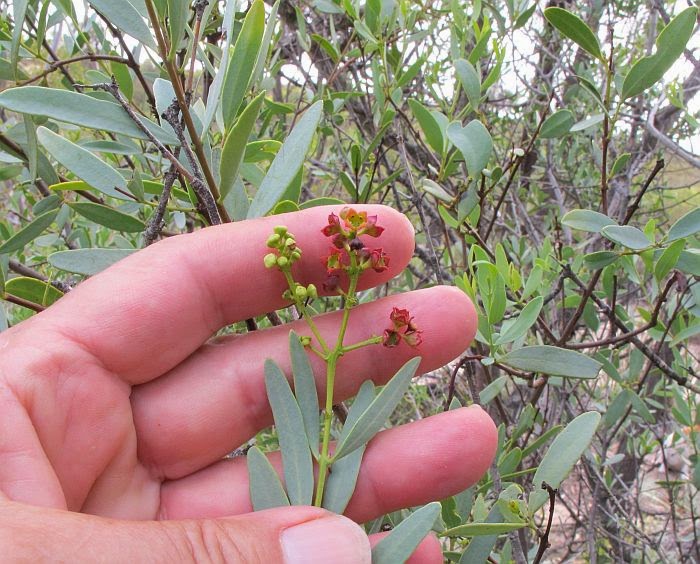
The flowers although small are quite colourful being red and orange when fully developed. They bloom from January to June, although with such a widespread species, the exact timing would be highly dependent on local climatic conditions. The Sandalwood like other members of the Santalum genus is a root parasite and taps into the root-system of other plants to exploit their water and nutrients, however few if any of these plants appear to be adversely affected.


Santalum is part of the Santalaceae family, which contains many other root parasites including such notables as Exocarpus and Choretrum.


18 February 2014

Santalum murrayanum - Bitter Quandong

Click image to enlarge

Santalum murrayanum - Bitter Quandong

This species is common across southern Australia although locally it seldom occurs in large colonies, but as scattered individuals or small groups, the seed having been transported via the droppings of emus and deposited randomly as they travel about. Like the other four Australian Quandong species, they are root parasites, which is where they obtain most of their nutritional requirements.

Santalum murrayanum occurs roughly south of a line from Kalgoorlie (WA) to Bourke (NSW), with most collections from southern SA and northern Victoria. Over its range it is found in a number of habitats, but locally shows a marked preference for heavy sandy loams over crumbly limestone, or occasionally on gypsum mounds around saltlakes.

The Bitter Quandong is a handsome weeping tree to 5 metres (16’) in height (juveniles can be shrubby), with attractive hanging soft veil like foliage. The leaves have a hooked tip and can be found growing in pairs or in whorls of three on the same plant, the latter being a good identification feature. The fruits (2 cm or nearly 1” diameter) are of similar size to the Sweet Quandong, Santalum acuminatum, but mature to a green/yellow or a dull mustard/orange colour, instead of shining bright red. Also the epicarp (seed) is less pitted than the Sweet Quandong, although this can be quite variable and is not so good for identification as the foliage differences.

As the common name of Bitter Quandong suggests, it is not suitable for human consumption, although Aboriginals ate the seed, which they probably roasted over a fire. The initial green flowers mature to a yellow/green exterior and at least locally, to internal orange petal like (perianth) lobes. Flowering in WA can occur anytime from October to January.

The Santalum genus belongs to the Santalaceae family, along with Exocarpos and other root parasites.


23 April 2013

Santalum acuminatum – Sweet Quandong

Click image to enlarge

Santalum acuminatum – Sweet Quandong

This is an extremely widespread plant, occupying the lower 2/3 rd of Australia (excluding Tasmania and east of the Great Divide), consequently with such wide distribution it will vary tremendously throughout its range. As an example, although I knew this species well from WA where very common, when in the NSW outback some years ago, such were the differences I had to key it out from scratch in order to be sure of its identity.

The main confusion identifying the Quandong is with the leaves, which can be straight, curved, the leaf tips, acute or acuminate, fleshy or less so, olive green to mustard in colour, although always arranged in pairs (opposite) along the stems. It has a wide acceptance of habitat and soil type and will happily grow over limestone or granite, in sand, on rocky or gypsum soils, etc. But being a root parasite, soil type is not overly important, as it will take nutrients from its host that are adapted to the habitat, whatever that might be.

Santalum acuminatum can grow to 7 metres (24’), but is usually much shorter, growing as a shrub or bushy small tree, but in impoverished environments can be quite spindly. The bright red ripe fruit is a very distinctive feature, which is used to attract birds and animals like Emus that will eat them and so spread the seed far and wide via their droppings. Aborigines have consumed these tart fruits for eons and newcomers more recently in jams and preserves, something that is continued to this day with demand commonly outstripping supply.

The flowers are arranged in a panicle that is shorter than the leaves; each flower is small being only 3-4 mm (1/8”) diameter, which open wide for flying insects to pollinate. There are no petals, only four fleshy sepal-like segments, however the fruits grow to 2.5 cm (1”) in diameter and are initially green, but change to a bright red when ripe; they contain a large hard and strongly pitted endocarp (seed). The degree of roughness of this endocarp can assist identification of Australian species and old ones can usually be found under mature plants.

Around Esperance Santalum acuminatum is largely confined to mallee country where it can be common around low-lying granite outcrops and saltlakes, particularly where there is a limestone substrate. Consequently this species is rarely found within 50 or more kilometres (30 miles) from the coast.

The genus Santalum belongs to the Santalaceae family, along with other local genera like Choretrum, Exocarpos and Leptomeria.