Showing posts with label Lentibulariaceae - Utricularia. Show all posts

29 November 2014

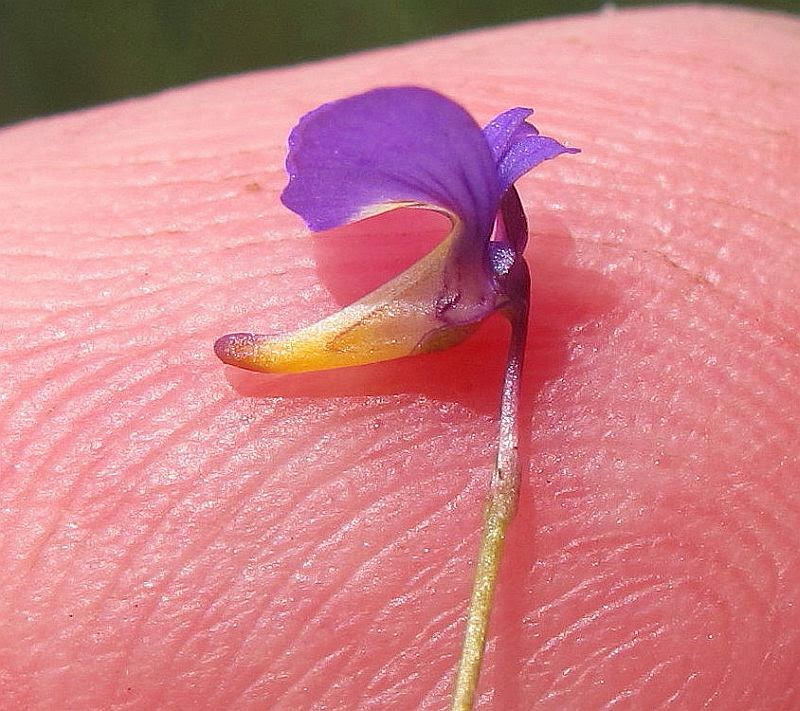
Utricularia violacea - Violet Bladderwort

Click image to enlarge

Utricularia violacea - Violet Bladderwort

This brightly coloured Bladderwort occurs mainly in near coastal areas from the Geraldton region (north of Perth) to Israelite Bay (east of Esperance), it then crops up again in the southern boarder region of SA and Victoria, plus is also known from NW Tasmania and Flinders Island. Locally it commonly grows with Utricularia dichotoma, although that species generally prefer deeper water whilst Utricularia violacea tend to be around the swamp edges in shallow water that dry during summer.

The solitary flowering Violet Bladderwort is an annual herb that rarely grows more than 15 cm (6”) in height and is usually much less. From September to December in the habitat photograph above, it may be found around the edge of deep pools, where sunlight is uninterrupted by taller vegetation.

It is worth keeping an eye open for a similar species called Utricularia inaequalis, that overlaps and occurs at much the same time, however that species has much larger flowers (roughly the size of your thumb nail, whereas flowers of U. violacea are more the size of your little finger nail).

Utricularia is part of the Lentibulariaceae (Bladderwort) family.

28 December 2012

Utricularia dichotoma - Fairy Aprons

Click image to enlarge

Utricularia dichotoma - Fairy Aprons

This very widespread species (also known as the ‘Purple Bladderwort’) also occurs in SA, Tasmania, Victoria, NSW and Queensland, but in WA is restricted to reasonably permanent freshwater pondage, which are not common with our normally dry summers and sandy soils. It is officially only recorded for the Esperance, Stirling Range and the Perth regions, although is probably more widespread elsewhere but not collected.

To the east of Esperance it can be found in swampy roadside areas where the road has been built up across swampy ground and in the process creating a dam-like structure on the upper side, of which native vegetation like Utricularia dichotoma have established themselves. In these wet peat/sand and mostly sedge habitats, this Bladderwort can be quite common growing either in the water and/or surrounding waterlogged ground.

Utricularia dichotoma grows to around 30 cm (12”) in height, but out of water is commonly half this size. The small oval shaped bladders have several trigger hairs which when touched can quickly open a bladder door to catch small pond-life by the in-rush of water. There is a small rosette of linear leaves at the base of the stem, which along with an uppermost single flower, can in addition support one to four pairs of flowers (1-9 in total), or one to three whorls of three.

The time of flowering in other parts of Australia is known for every month except the two coldest of June and July, whereas in WA it is only been recorded for November, December and March. Although locally it can also flower as late as January and with the help of a summer storm, probably February too.

The Utricularia genus belongs to the Lentibulariaceae family.


23 October 2010

Utricularia westonii – Lentibulariaceae

Click image to enlarge

Utricularia westonii – Lentibulariaceae

Plants in the Utricularia genus are carnivorous by capturing via bladder-like traps, small aquatic or semi-aquatic organisms and due to this feature, are commonly known as Bladderworts. The flowers can be larger and more spectacular than this species by having a particularly large lower apron-like petal and because of this, are also called Fairies Aprons. Although Utricularia westonii has small flowers, it has large bladder type traps.

The family Lentibulariaceae has only the genus Utricularia, but not so long ago it had a second (Polypompholyx), now absorbed into Utricularia. The difference between these genera involved the number of sepals each had, with Utricularia 2 and Polypompholyx 4. I mention this as Utricularia westonii has 4 sepals, so originally had affinity with Polypompholyx.

Utricularia westonii has only been known from the Cape Le Grand National Park, but a couple of other colonies have been discovered a kilometre (less than a mile) south of the Mt Merivale summit, which is around 20 km (12.5 miles) north of Cape Le Grand. Here the main colony of several hundred individuals, is found on a slight sand/peat rise between two largely permanent swamps (surface water will dry during drought). When the first swamp fills (where Utricularia volubilis, the Twining Bladderwort occurs), it overflows into the second swamp, flooding the location of Utricularia westonii to ankle depth.

The overflow into the second swap due to seepage into the first and the sedge vegetation, can take a number of weeks to stop flowing and even then, the bladder traps are usually underwater. For this reason the bladders are not buried in the soil, but remain exposed on top and to 10 cm (4”) below the water surface. Even when they flower in normal (wet) years, they are still standing in water.

A second colony, 500 metres to the east, also occurs in a swamp but on the outer edge of a hollow that normally fills with water to a similar depth as the other colony, then overflows into a flood plain, so the water depth remains below 10 cm (4”). In this colony there are relatively few plants that are scattered around the eastern edge of the hollow.

These plants are probably more widespread in the district as this habitat is very common, with a vast number of small swamps linking to each other, the problem I think is the lack of fires to reduce the smothering sedge and other vegetation. In the habitat shot above with Mt Merivale in the background, a path is regularly slashed during autumn (when the ground is dry) to stop the vegetation from completely taking over. The Utricularia westonii plants only occur in these paths, but no doubt would also colonise the surrounding area if that were also slashed or burnt. The Mt Merivale district has many signs of pre-European aborigines and they were known to burn this type of country on a regular basis (see http://natureitems.blogspot.com/2006/12/fire-management-european-verses.html for further information).

Returning to Utricularia westonii, the bladders have three lengthy appendages and the trap door 6 long tripping bristles. The bladders themselves are to 5 mm (little under ¼”) in length, so quite large for these small plants. The plants will flower in a good (wet) season from October to December.

14 October 2010

Utricularia volubilis - Twining Bladderwort

Click image to enlarge


Utricularia volubilis - Twining Bladderwort


Bladderworts are also known as Fairies Aprons for obvious reasons and come from the insectivorous Lentibulariaceae family. Utricularia volubilis is an impressive perennial twining plant that grows to a metre (over 3’) in height, with large (2 cm or ¾”) purple flowers, but dies back to a corm during late summer, autumn and winter. To see them in flower you need gumboots as they are only found in ephemeral swamps, particularly those containing water well into summer, but of additional interest, they commonly grow with the equally large purple flowered Babe-in-a-Cradle Orchid, Epiblema grandiflorum var. grandiflorum (see post in orchid section).

Locally the Twining Bladderwort is only known from a few locations to the east of Esperance in a triangle from Cape Le Grand, Mt. Merivale and Duke of Orleans Bay. The next known occurrence is to the west of Albany (over 400 km or 250 miles away), where equally limited, then in a few scattered populations to Perth. However, I suspect it is far more common, but you need to be looking in the right place at the right time. Utricularia volubilis needs periodic bushfires to reduce the build-up of sedges within swamps that will otherwise smother them, although this may take several years, but usually after 5 years they are greatly reduced. As bushfires in the region often span much longer periods, timing is therefore most important. Secondly, very few people, even keen naturalists will wade into swamps on the off-chance of finding something of interest, plus it is not helped by the sparse human population between Albany and Esperance, so not surprising they haven’t been discovered there.

The water level when Utricularia volubilis is flowering is mostly below the knees and often at ankle depth, but the base of the plant with the bladders is usually submerged for most of the year. The bladders are much larger than most other Utricularia spp., being close to 5 mm (nearly ¼”) in length and are well adapted to capture prey in their aquatic environment.

The Twining Bladderworts tightly wrap themselves around the sedges and will climb until they reach an open sunny position; there the flowers (usually in pairs) develop and being large, colourful and common where found, can be spotted from some distance, although they may only occur in a small portion of a large swamp. Flowers continue to form from September to December, so for the enthusiastic nature lover, a pre-Christmas ramble in gumboots can be well worth the effort.


Update 14/10/2010
Two photos added and two substituted, one showing a trap with activating hairs.

23 April 2010

Utricularia tenella – Pink Bladderwort

Click image to enlarge

Utricularia tenella – Pink Bladderwort

Utricularia tenella is an annual species and one of the smallest insectivorous bladderworts. The flowers are less than 5 mm (under ¼”) diameter and a delicate pink color, whilst the stems vary from 2-8 cm (3/4”-3”) in height. The feature of note however is the nectary spur (below the petals) that is roughly the same length as the covering central petal-like structure. I mention these features as there is a similar looking bladderwort called U. multifida that grows in the southwest portion of the State, but with that species the flowers and stems are usually much larger, although the nectary spur is only half as long as the central petal-like structure.


Both of the above Bladderworts were previously placed in the genus Polypompholyx (the pronunciation should not be attempted after a night on the town) and were known as Polypompholyx tenella and P. multifida. This separation was due to the number of sepals (calyx lobes that initially enclose the bud) that each genus had, with Polypompholyx having 4 and Utricularia 2, but now Polypompholyx has been absorbed into Utricularia. The sepals can be seen at the base of the ovary (without the petal-like structure) and developing into a seed capsule.


The Pink Bladderwort is known to occur to the east of Esperance, but to the west there is a gap until Bremer Bay, then largely around the coast in scattered colonies to the north of Geraldton (a considerable distance). It is also found inland, but always within the Wheatbelt region and not recorded for the drier Mallee. 


Being a small plant, Utricularia tenella requires an open situation, so is found in shallow soils on moss covered granite outcrops where other vegetation is limited, or wet heath where soils are peat/sand with fine clay that dries hard during summer, but will hold water after heavy rain. Again a habitat that provides many open spaces as the wet/dry conditions are too harsh for most larger smothering plants. Very often after heavy rain a few shallow depressions will fill with rainwater, but these usually evaporate or drain after a few days. However moisture retained in the peaty soil is sufficient for micro semi-aquatic life to survive and provide Utricularia tenella via their tiny (1.5 mm or 1/12” dia) traps with essential nutrients.


Being an annual species, their lifespan is invariably short and reliant on moisture availability, therefore they set seed readily and quickly, but it also means you need to be in the right place at the right time or you will miss them. They are recorded as flowering from August to November, but these times are very reliant on the reliability of seasonal rainfall. Locally, late September and October are usually the best time to catch them.

11 April 2010

Utricularia menziesii – Redcoats

Click image to enlarge

Utricularia menziesii – Redcoats

Plants in the genus Utricularia belong to the Lentibulariaceae family, but are commonly known as Bladderworts. They are carnivorous herbs (non-woody), trapping and consuming small aquatic animals by use of a bladder (as a replacement of true roots), which when touched spring open to suck up the animal with the inflow of water. The animal slowly decomposes to provide the plant with nutriments in their otherwise nutritionally poor habitat.

Each bladderwort has a number of traps with one at the end of each stolon (root-like) that emanate from a central corm (plant producing bulb-like structure), so plants are often in small groups. The traps are relatively small, between 1-2 mm (less than 1/8”) in length, but so are their prey, which is anything small enough to be sucked into the bladder.


Utricularia menziesii is a very common and widespread plant (from Israelite Bay east of Esperance to the north of Perth) on near coastal moss covered granite outcrops, or on the edge of drainage channels carrying flood water from one swamp to another. They don’t actually grow in water, but in waterlogged soils, particularly those that are slow moving or draining, which probably carry living organisms their way.


The beaming red flowers are between 2-3 cm (1”) in length and despite their fragile appearance, will bloom over several weeks providing the moisture does not dry up. When conditions do become too dry Utricularia menziesii will die back to the corm, where it will remain dormant until the following growing season. The flowers themselves do not trap insects, but are functional and serve only to attract suitable pollinators. Flowers are produced from June to September and are well worth seeking out.