Showing posts with label Goodeniaceae - Dampiera. Show all posts

01 November 2011

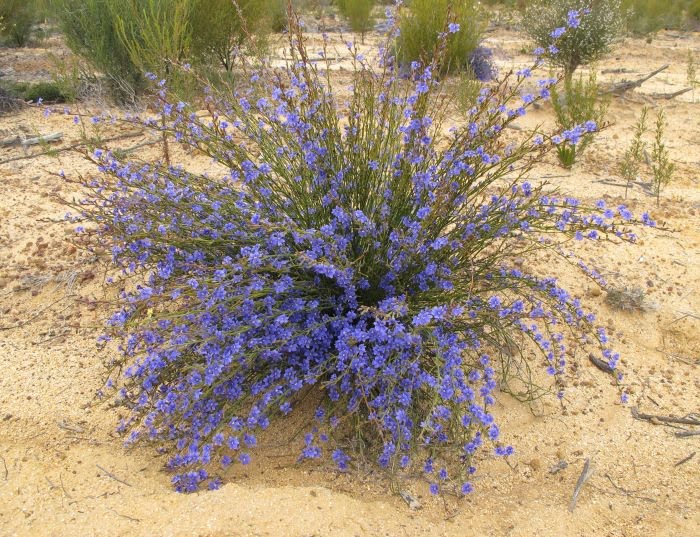
Dampiera fasciculata - Bundled-leaf Dampiera

Click image to enlarge

Dampiera fasciculata - Bundled-leaf Dampiera

The genus Dampiera belongs to the large and often highly colourful Goodeniaceae family. These are largely fast growing herbaceous species, usually amongst the first to germinate after a bushfire and readily colonising disturbed soils. However, most are relatively short lived and largely disappear after a few years as larger plants begin to dominate.

Dampiera fasciculata is so named because of the leaf clusters on the upper branches; it is also recognised by the triangular shaped stems that have rounded corners. It is a very common sub-shrub particularly around the coast (although it also occurs inland in non-calcareous sandy soils) from Cape Arid (east of Esperance) to the west of Albany. It is found in most heath areas, around granite outcrops and on gravel soils, plus being a colonising species is often seen along roadsides.

In open habitats the Bundled-leaf Dampiera is a spreading clumpy plant to ½ metre (20”) in height, or when young or growing near larger species as a more scraggly semi-prostrate one. The flowers are mostly deep blue, although some can be paler, but all are colourful and very eye-catching. Flowering is recorded from August to November, although with good rainfall and mild temperatures, this can be extended to the end of the year.

03 August 2010

Pouched Dampiera - Dampiera sacculata

Click image to enlarge

Pouched Dampiera - Dampiera sacculata


Dampiera is a common and widespread genus with its highest concentration in the higher rainfall areas of Western Australia. They are mostly small herbs or sub-shrubs and like many in the family Goodeniaceae, do best after bushfires and in disturbed soils. Consequently they are commonly found along roadsides, whereas in neighbouring mature (unburnt) bush only a few plants may survive in open areas between taller vegetation.

A common misconception of any blue flowered plant from this group is, it must be a Dampiera, but this is generally not the case as many others and often hardier species in Goodeniaceae are more plentiful. The easiest way to determine a Dampiera, is to open out the flower and check the sides of the two corolla lobes (petal-like) that are often together to form a keel like structure below the three other lobes. Along the inner lower edges, there will be pocket called a auricle, which looks like the pocket formed by an extra skin flap on the outer lower edge of a dog’s ear. This pocket is a highly distinctive feature of plants in the Dampiera genus.

Dampiera sacculata has upright stems that arch over as they develop, particularly with the weight of flowers that form over much of its length. The deep blue flowers have a yellow centre, however it is the small pouch formed by the bulging ovary at the flower base that is distinctive and what gives this plant its name. This floral pouch in the gibbous ovary (quite separate from the auricles) is formed from a single (growing) seed, which is curved back upon itself (end to end) and contained in the ovary by the pouch.

The Pouched Dampiera grows to ½ metre (1’6”) in height and occurs from Israelite Bay (east of Esperance) to the Albany district (west of Esperance), then north but within the wheat growing region to the NW of Perth. Flowering is recorded from May to November, but this would depend on local weather conditions, particularly rainfall. Many Goodeniaceae, especially herbaceous species are fast growing and very opportunistic by quickly coming to bloom after any reasonable rainfall.


Update 12/09/10
Photographs of an interesting pink form included. It was the only plant of this color amongst many hundreds of blue ones.