Showing posts with label Ericaceae - Brachyloma. Show all posts

11 September 2015

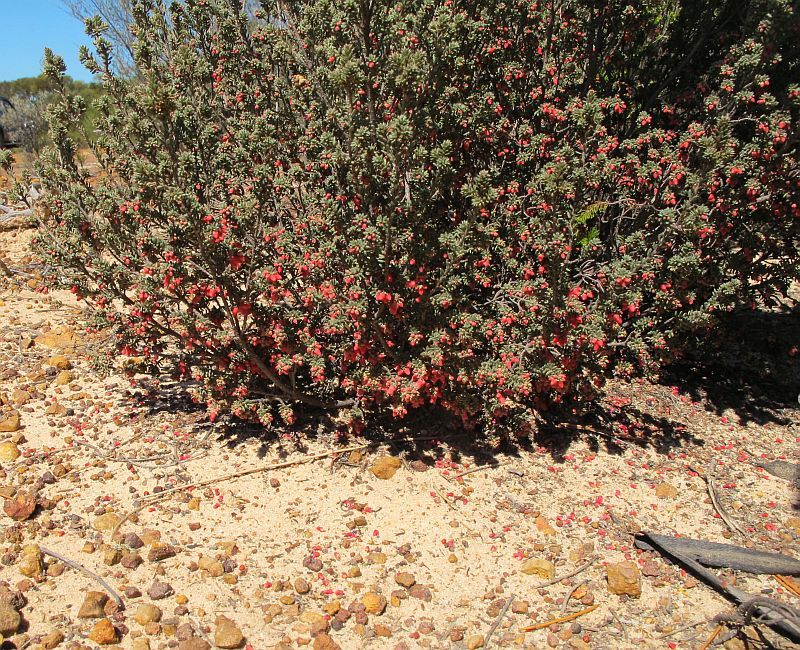
Brachyloma moolya

Click image to enlarge

Brachyloma moolya

According to the WA Herbarium, Brachyloma moolya is a tentative name, recognised only in manuscript form, having not as yet been published. Apparently, additional study is required to establish its individual status, or whether it is part of a more complex group. The details below are from the Lake Tay region, where common in deep yellow sand, especially on the upper slopes of large sand hills.

Brachyloma moolya is largely an inland species of mallee heath and open woodland, although also noted from the Cape Arid district and the Fitzgerald River National Park. Most records however are further north, from Gnowangerup to Hyden, then east to Lake Tay (around 140 km or 85 miles NW of Esperance).

It is a compact shrub to around ½ metre (20”) in height and is noticeably green in its dry habitat amongst shrubs of predominantly grey, silver or pale green. The pinkish red flowers although small (6 mm or ¼” in length), are plentiful and produced over a long period, as evidenced by the spent detached corollas (floral tube and petals) that litter the ground.

The leaves are of similar length to the flowers and densely cover the numerous branchlets to provide a dense background upon which the brightly coloured flowers are positioned like Christmas decorations. Continuing on the same ornamental Christmassy theme, the interestingly marked spherical fruits can also be numerous and due to the long flowering nature of this plant, often occur at the same time, although being green, require closer observation.

Flowers are produced at the growing tips of branchlets, and they will continue to be produced for as long as the plant grows, which depending on local weather conditions can be from June to November and possibly longer if conditions are mild and accompanied with decent rainfall.


Brachyloma is part of Ericaceae (Heath) Family, but may also be listed under Epacridaceae elsewhere.

My thanks to the WA Herbarium for identification.


09 September 2013

Brachyloma nguba – Blood-red Brachyloma

Click image to enlarge

Brachyloma nguba – Blood-red Brachyloma

The Brachyloma genus is an Australian endemic of less than 20 species that are distributed in all States except the NT, most of them are located in WA but many await official publication. The species name of nguba is a local aboriginal word for blood and refers to the bright red flowers.

Brachyloma nguba is restricted to a small area NW of Esperance and notwithstanding several colonies being discovered since its published description in 1998, it still retains its initial Priority One Conservation Code rating. This means it is known from only a few locations and is in need of further survey to establish if it is an endangered taxon.

More recent discoveries from Munglinup 100 km (60 miles) west of Esperance and (north) to the Frank Hann National Park, now place this plant within large tracks of undeveloped land where although still seldom encountered, makes it more secure. I have located several small colonies, in the Lake Tay region where it favours shallow sand over gravel, or deeper yellow sand in close proximity to gravel.

Plants are quite compact growing to around 80 cm (32”) in height and are generally well spaced, giving a distribution profile of seed that is spread randomly via the droppings of birds. Also the eye-catching red tubular flowers are ideally suited for honeyeating birds, which are likely to be the pollinators.

Much further west and mostly near coastal areas between Albany and the north of Perth, there is a similar species called Brachyloma preissii. But this species has much larger leaves of 8-17 mm (5/16”-11/16”) in length, whereas those of Brachyloma nguba are only 2-3 mm (less than 1/8”) in length.

Flowering is recorded from April to May, but my observations also has it in full bloom during August and March, which suggests this species is opportunistic to unseasonal rainfall and will possibly flower whenever suitable conditions present.

The genus Brachyloma is contained within the Ericaceae family (formally Epacridaceae).

Reference:
Nuytsia Vol 12 (1998)
Brachyloma nguba (Epacridaceae), a new species from the south-west of Western Australia
by RJ Cranfield.