Showing posts with label Myrtaceae - Eucalyptus. Show all posts

04 July 2014

Eucalyptus occidentalis - Flat-topped Yate

Click image to enlarge

Eucalyptus occidentalis - Flat-topped Yate

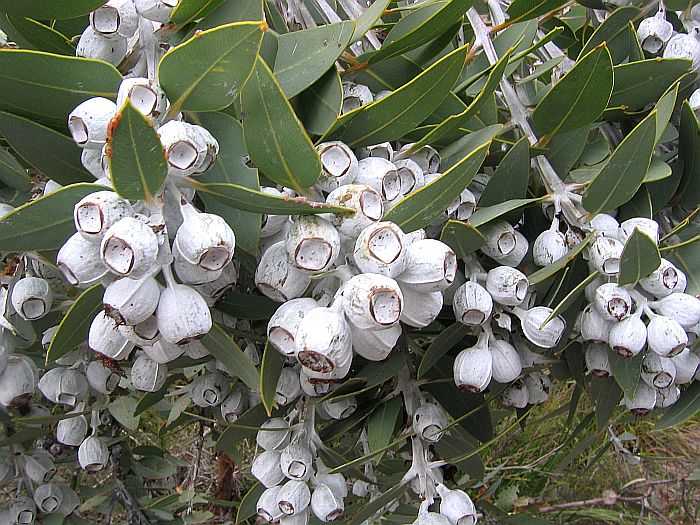
This eucalypt is one of the tallest in the Esperance region and a very hardy species, able to withstand prolonged periods of dry or wet conditions. Locally it favours hollows along light drainage zones, which are seldom more than 5 hectares (12 acres) in area that can flood (winter/spring) during a wet year to a metre (3’) in depth. The topsoil is often a heavy loam over clay, which is slow to drain, but nevertheless will dry out completely by the summer/autumn and without decent rainfall can remain so for several years.

In coastal areas the Flat-topped Yate commonly grows as a mallee (multi-trunked), whilst usually a tree (single trunked) inland (to avoid confusion the term mallee applies to either a multi-trunked eucalypt, or an inland district where many mallee eucalypts grow). From the two full length photos above, it can be seen the coastal eucalypt due to the higher rainfall is growing with other vegetation, which in the event of a bushfire this extra fuel load will ensure all are burnt.

After a bushfire the coastal Eucalyptus occidentalis will regenerate from an underground lino-tuber to grow two or more new trunks, these eucalypts tend to be shorter, but wider than the inland form, seldom growing more than 15 metres (50’) in height. On the other hand the inland form, due to lower rainfall (average around 30 cm or 12” year) have very little ground cover, so can grow for many years without being seriously burnt and so retain a single trunk. Trees however on the outer edge of the habitat and mixed with taller vegetation are commonly burnt and may also develop a mallee (multi-trunked) form. These inland trees can reach 25 metres or over 80’ in height.

The unpredictable habitat of this eucalypt has made it a very hardy species, even tolerating alkaline and saline conditions, so is commonly used for wind and shelter breaks around farming properties. The timber is hard and durable and besides being good fuel, has also been used for poles and fence posts. The cream or white flowers produce large quantities of nectar and bloom in autumn when there are few other flowering plants about, it therefore attracts many honeyeating birds from far and wide, which usually also have to compete for the nectar with feral honey bees.

Eucalyptus occidentalis is a WA endemic, naturally occurring in near coastal environments from Israelite Bay (east of Esperance) to the Albany region, but also extends inland to around 150 km (95 miles), where it is less common. Flowering is officially recorded during two periods from September to December and from January to May, however near Esperance it is not unusual for them to flower off and on from January to August.

This species can be easily identified in the field by the flaky rough bark at its base that extends up the trunk to at least the first branch, but with an upper section that has an attractive smooth light coloured bark.


Eucalyptus is part of the very large and highly diverse Myrtaceae family.

12 May 2014

Eucalyptus perangusta - WA Narrow-leaved Mallee

Click image to enlarge

Eucalyptus perangusta – WA Narrow-leaved Mallee

This eucalypt grows very much like a shrub, especially for a few years after bushfires as it has low foliage growing from numerous slender trunks.  Locally it is commonly 2-3 metres (8’) in height, but older trees can grow to twice that size and tend to lose their shrubby appearance when the lower foliage drops to exposed the smooth trunks.

The leaves are to 0.5 cm (3/16”) wide by up to 9 cm (3.5”) in length.  They also have a hooked tip, not unlike the more coastal E. uncinata, but are easily separated by the paired juvenile leaves, which are joined with E. uncinata, but quite free with E. perangusta.  When juvenile foliage is not available, the mature foliage, buds and fruits are much smaller with this species.

The buds are to 0.8 x 0.3 cm (5/16”x 1/8”) and are in clusters of 7, which when in flower produce a collective flower ball of around 2 cm (nearly 1”) diameter.  These are enhanced by several floral clusters along each stem to produce a mass display of white flowers, which are eagerly sort by insects, especially the large Jewel Beetles and honeyeating birds.  The resulting fruits are cupular to 0.5 x 0.4 cm.  Flowering (depending on local weather conditions) is from November to March,

Eucalyptus perangusta favours sandy soils, particularly over gravel or clay and is common inland to 200 km (125 miles) NNW of Esperance, then West to the Hyden region, SW to Gnowangerup, returning East to Jerramungup (100 km West of Esperance). 

Eucalyptus belongs to the very large and highly diverse Myrtaceae family.

Reference:
Eucalyptus foecunda revisited and six related new species (Myrtaceae)
By MIH Brooker (CSIRO)
Nuytsia
Vol 6.   No 3.  1988.

25 June 2013

Eucalyptus depauperata - A red-flowering species

Click image to enlarge

Eucalyptus depauperata - A red-flowering species

This small mallee eucalypt is very similar to Eucalyptus eremophila subsp. eremophila (see here), and was once lumped in with that species as I also did, until I had reason to view my complete collection of specimens. It then became apparent that I had two species, one with much smaller buds and fruits (difficult to appreciate from photographs), which turned out to be Eucalyptus depauperata. The total bud length of Eucalyptus depauperata is less than 2.5 cm (1”), whilst those of E. eremophila are generally well over that size.

As with Eucalyptus eremophila, the flowers of this species are yellow or red, but to me are more intense and also like the former the yellow flowered plants are much more common. However I did see a number of red ones when I kept an eye open for them and consider these plants although still rare, to be much less so than E. eremophila.

Eucalyptus depauperata has a much smaller distribution than E. eremophila, occurring only in an inland mallee region from Lake King to the Peak Charles region, where it commonly grows in sandy soils especially over gravel. Throughout this region Eucalyptus eremophila is also common, so they are easily confused.

Besides the smaller buds and fruits, Eucalyptus depauperata is also a shorter growing mallee, seldom exceeding 4 metres (12’) in height and commonly around 2 metres when it tends to flower for the first time. The WA Herbarium FloraBase has this eucalypt flowering in September, whilst in the Field Guide to Eucalypts Vol.2 by Brooker and Kleinig it is listed from December to February. From my observations Late November to Late January was the situation, but these times will vary depending on local weather conditions.

The genus Eucalyptus is part of the large and very diverse Myrtaceae family.


08 March 2013

Eucalyptus pleurocarpa – Tallerack

Click image to enlarge

Eucalyptus pleurocarpa – Tallerack

This eucalypt is a very common species between Esperance and Albany, extending inland to Peak Charles and the Hyden district. Around Esperance it is also found in sandy areas to the northeast of the township in the Mt Ridley region, but not in the far eastern or near coastal districts after Cape Le Grand, which is occupied by a similar looking mallee called Eucalyptus extrica (differences explained later).

Eucalyptus pleurocarpa was known as Eucalyptus tetragona, but this is now only used to describe a hybrid between E. pleurocarpa and E. extrica, also found in the coastal regions east of Esperance (more details later). Eucalyptus pleurocarpa grows in non-calcareous sandy soil, sometimes over gravel or limestone and is a common feature of open heath and shrubby woodland. In coastal areas it seldom exceed 4 metres (13’) in height, but in mallee regions it commonly reaches 6-8 metres (20’- 26’) in height. These tall mallees are generally represented by several bare trunks, growing from a large subsurface lignotuber with the foliage restricted to the upper parts, but are nevertheless still quite impressive.

This species is readily identified by the glaucous foliage, stems, buds and fruits that glow pale blue and white even from a distance. The similar looking species E. extrica to the east of Esperance, lacks this glaucousness and the leaves are green. The hybrid between these two is known as Eucalyptus x tetragona and is similar to E. extrica, but instead of green foliage, has light glaucous foliage.

Most eucalypts have a juvenile type foliage often quite unlike when adult, but some species like Eucalyptus pleurocarpa retain this juvenile foliage for life and with little modification, except with this species the leaves might vary from elliptical to broad ovate (more tapered top). The white flowers are arranged in threes and are often grouped towards the ends of branches, which coupled with the large white square fruits can produce interesting and attractive displays over several months, although November to February is when they usually bloom.

The flowers are mostly pollinated by insects, but are visited by a number of animals, as just about anything crawling over them would probably do the pollinating job. The only drawback in some areas with this eucalypt, is the attractive leaves can also be of interest to some leaf-cutting insects that can spoil the look of the plant, but the advantage being that with the next season’s growth, they will start afresh and can if required, be used in cut flower arrangements.

The Eucalyptus genus is part of the large Myrtaceae family.


28 January 2013

Eucalyptus platypus subsp. congregata - Moort

Click image to enlarge

Eucalyptus platypus subsp. congregata - Moort

This handsome small tree growing to 8 metres (26’) can occur as an individual or more often in congested colonies (as the subspecies name of congregata suggests). It is described as a Marlock, which is a unique WA tree classification denoting that the eucalypt is without a lignotuber, has a slender trunk with dense foliage along its spreading branches. However, from the multi-trunk situation often observed, there seems to be some sort of underground branching mechanism, thereby (for what it is worth) commonly making it Mallee-like in the Esperance region.

This eucalypt is very common on the edge of the mallee country from the north of Esperance, spreading west to Jerramungup (100 km or 60 miles west of Ravensthorpe) in a band 80 km (50 miles) wide, and approximately 30 km (20 miles) from the coast. Here it is frequently found in a heavy loam over clay or gravel, and favouring lowlying or seasonally wet seepage areas.

The trunks are smooth and depending on the time of year, can be green/grey, silver/grey or copper/grey. The 7-flowered cluster is supported on a long pendant, strap-like peduncle and as they generally bloom at the same time, produce a highly ornamental floral display up to 10 cm (4”) across. The flowers bloom from January to March and are commonly greenish at first, but generally mature to yellow with a slight greenish tinge. They are bird as well as insect attracting, plus no doubt any other local nectar feeder.

The features that distinguish this species from any other are the pendant flowers on long peduncles and the thick elliptical leaves, which are around 2.5 cm (1”) in width. The other subspecies (subsp. platypus) has more oval leaves that are around 3.5 cm (13/8”) wide. The peduncles are also often shorter with subsp. platypus, but apparently not always. It partially overlaps with subsp. congregata from the Munglinup area (100 km or 60 miles west of Esperance) and further west to the extent of its distribution, whereas subsp. platypus extends further to the Katanning district north of Albany.

The Eucalyptus genus is one of the many genera within the large and diverse Myrtaceae family.