Showing posts with label Proteaceae - Banksia. Show all posts

25 September 2012

Banksia pallida – Proteaceae

Click image to enlarge

Banksia pallida – Proteaceae

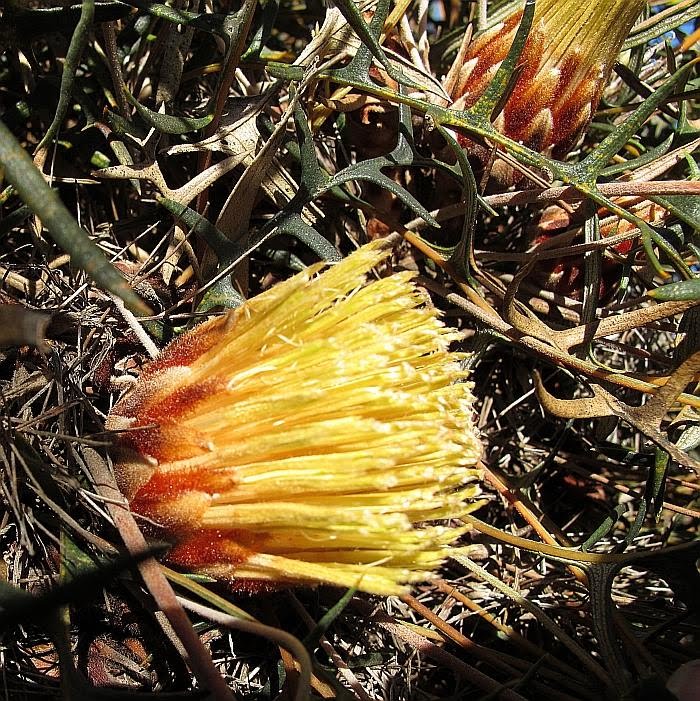
This species (previously known as Dryandra pallida) only just gets into the Esperance region; the colony above contains many hundreds if not thousands of plants and is possibly the most easterly known. Its previous most easterly location was the Frank Hann National Park, which is around 50 km (30 miles) to the NW of this colony (south of Lake Tay). Banksia pallida is apparently common in the southern central wheatbelt from Nyabing (170 km or over 100 miles north of Albany) to the Frank Hann National Park (180 km or 110 miles NW of Esperance).

Banksia pallida is recorded growing to 2.5 metres, although south of Lake Tay they were currently less than a metre in height, having grown after a bushfire 3-4 years earlier. However they retain the columnar growth habit, but later branch near the base to produce a more bushy upright structure. The local soil type is a light sandy loam, probably over gravel. The leaves are held stiffly and being armed with sharp points, are quite prickly and difficult to handle without gloves.

The yellow flowers (to 2.5 cm or 1” diameter) are made up of several dozen small flowers that are densely hairy on the outside, whilst their hairless style is topped with a distinctive small red stigma (pollen presenter). Flowering is recorded from May to August, with the local colony having a good year by extending this into September.

The Banksia genus belongs to the large and highly ornamental Proteaceae family.


11 September 2012

Banksia armata var. armata - Prickly Dryandra

Click image to enlarge

Banksia armata var. armata - Prickly Dryandra

Until recently, Banksia armata was known as Dryandra armata, but the Dryandra genus has now been discontinued and absorbed into the Banksia genus. There are two varieties of Banksia armata and both are found within the Esperance region, with mature plants of var. armata tending to be shorter (to 1.5 metres or 5’ in height), plus having a lignotuber from which it can quickly regrow after bushfires. The var. ignicida on the other hand can be taller (to 3 metres or 10’ in height, although seldom above 2 metres locally) and does not have a lignotuber, so must regrow from seed after fire.

The var. ignicida tends to be a little larger in most respects, with slightly larger flowers and broader leaves, but these alone will not clearly distinguish between them. Probably the easiest method is to count the number of lobes on one side of the leaf, with var. armata having between 6-13, whilst var. ignicida only 5-8.

Banksia armata var. armata is more widely distributed than var. ignicida and stretches from Kalbarri to east of Esperance, whereas var. ignicida extends from a little east of Perth to Albany and then also to the east of Esperance. Both varieties will tolerate a variety of soil types, but sand over gravel, rock or granite are the most popular.

The common name of Prickly Dryandra for these plants is very apt, as they are extremely so and commonly draw blood when being handled. The flowers that are around 2.5 cm (1”) diameter can be cream or yellow and both varieties bloom between June to October, although the more northerly populations are usually first to flower and the southern ones last.

The Banksia genus belongs to the Proteaceae family.


21 June 2012

Banksia media - coastal form

Click image to enlarge

Banksia media - coastal form

Banksia media is a common and widespread Banksia located between Albany and the Nullarbor, plus inland to mallee regions. Such wide distribution will usually produce different forms based on habitat type, of which the coastal form is hereby compared to the inland variety. The inland form is usually a small tree 5-10 metres (30’) in height and commonly occurs in deep non-calcareous sandy soils, often with a clay or laterite substrate. The coastal form is rarely more than 2 metres (7’) in height and is mostly a bushy spreading shrub, preferring moderately calcareous sandy soil often over limestone.

In habitat, the (coastal) Banksia media usually grows within a kilometre (1/2 mile) of the coast and is often the tallest shrub in the windswept landscape; it is also very compact and spreading to 4 or more metres (over 12’), offering shelter to mammals, birds and more delicate vegetation. This low spreading habit is also retained when grown away from the coast in less windy conditions.

The large yellow flower spikes (15 cm or 6”) in height, also provide nectar to many animals from March to August, and even to December if weather conditions are favourable. The foliage of the coastal form is greyer than the inland form and although the flowers are similar in appearance, they are slightly smaller (20 cm or 8” for the inland form). In the Esperance region, some exposed near coastal plants develop a semi-prostrate form, but apparently in the Albany region there is another variety that is completely prostrate, although not seen locally.

The inland Banksia media form may be seen here.


16 March 2010

Scarlet Banksia - Banksia coccinea

Click image to enlarge

Scarlet Banksia - Banksia coccinea

Robert Brown who accompanied Matthew Flinders on the first circumnavigation of Australia in 1801 made the first scientific collection of Banksia coccinea. He took it from Albany, which along with the Stirling Range is the heartland of this species. It is unfortunately very rare in the Esperance region and I have only seen it around Young River 70 km (44 miles) west of Esperance (its most easterly distribution), however there are several large tracks of bushland in the Young River district, including the Stokes National Park, so may be more common than I have observed.

The Scarlet Banksia is a very spectacular species with its blood red terminal flowers (10 cm or 4" diameter) and chunky foliage. For this reason it has always been a popular cut-flower and is exported to several countries. Collection from wild stocks is not encouraged these days as the fatal dieback disease Phytophthora cinnamomi of which Banksia coccinea is highly susceptible, can be spread by collectors travelling between colonies.


Apparently Banksia coccinea can grow to a height of 8 metres (26’), although I have only seen them to less than half that height. It is not a bushy shrub, but usually an upright plant with a few lateral branches, although sometimes growing close to each other to form a small thicket. The Scarlet Banksia grows in a shrubby heath/woodland environment, preferring sandy rises and flats, often around ephemeral swamps, drainage zones or flood plains.


Another attractive feature of this shrub or small tree is its long flowering period, officially recorded from May to January making it an important food plant for the Honey Possum, Honeyeating Birds and no doubt many others.

26 November 2009

Tangled Honeypot - Banksia pteridifolia subsp. pteridifolia

Click image to enlarge

Tangled Honeypot - Banksia pteridifolia subsp. pteridifolia

The Tangled Honeypot was previously known as Dryandra pteridifolia and close to Esperance it occurs in shallow sand over gravel, or directly on gravel mainly along roadsides 20-30 km (15 miles) from the coast. Not uncommon to the NE of the town along Scadden Road, and NW between Lort and Young Rivers particularly along Beltana and Neds Corner Roads. It is also known from the Cape Le Grand area. Banksia pteridifolia subsp. pteridifolia is the only subspecies in the Esperance region.

It lives up to its common name of Tangled Honeypot as the stiffly arching, deeply toothed 35 cm (14") long leaves grow into each other to form dense grey/green domes to 80 cm (2'8") in height by 1.2 metre (4') diameter. The honeypot flowers are often buried deeply within this tangled vegetation and completely hidden from view, so how the pollinators (other than honey and pygmy possums) could get to them is a wonder. Birds would only be able to reach the flowers when the plants were young and the blossoms reasonably exposed.


Banksia pteridifolia subsp. pteridifolia has a lignotuber, permitting it to quickly regrow after bushfires from its root-system, whilst most other species require mass seed germination to perpetuate itself. This lignotuber feature would permit the Tangled Honeypot to be less dependant on seed, so limited pollination by birds in its early years may be sufficient, as only a few new plants produced this way would ensure its long-term survival.


The Tangled Honeypot is recorded flowering from March to May, which seems to correspond with most plants examined, yet the one photographed above was flowering in November and would probably do so for at least another month. These odd flowering times are not unusual in areas of limited and varying rainfall, when many plants become very opportunistic and will take advantage of unusual seasons or habitat variation. So it is worth examining, particularly with Proteaceae, plants in different habitats as flowering out of season frequently occur.

26 October 2009

Banksia petiolaris

Click image to enlarge

Banksia petiolaris

Banksia petiolaris is an attractive prostrate shrub that can cover an area of several square metres, although it is impossible to tell if other plants are growing with it. These clumps with their near vertical lightly lobed grey/green leaves are quite distinctive in its small-leaf heathland habitat and will draw your attention even when not in flower.

It grows in well-drained deep sand, or sand over gravel in relatively flat or gently undulating country, from around 100 km (60 miles) west of Esperance, to 40 km north in the wheatbelt (south of Mt Burdett), and progressively to the heaths of Israelite Bay 200 km east of Esperance. It is not particularly widespread, but once encountered it is often very common, occurring in extensive colonies.


Unlike some other prostrate banksias, the branches of Banksia petiolaris are above ground, so when periodic bushfires pass through the plants are killed, but grow again from the seed held in the fire resistant follicles that open to release it once the fire has passed. They germinate quickly and are quite fast growing, so it is not long before new plants are once again producing flowers and seed. In the act of reproduction they are helped with pollination by birds and probably the Honey Possum, plus invertebrates possibly play a part.


Flowering is from September to December, although they tend to begin and finish a little later in a good rainfall season when the soil surface has completely dried and less likely to become seriously wet from further rainfall.

26 July 2009

Esperance Banksia - Banksia prolata subsp. calcicola

Click image to enlarge

Esperance Banksia - Banksia prolata subsp. calcicola

Previously known as Dryandra longifolia, Banksia prolata is a very attractive Proteaceae species endemic to the Esperance district. There are three subspecies and all of them are listed as Rare Flora. Subspecies calcicola, has a Rare Priority One listing, which represents plants known only from a small number of colonies and in this case also of limited distribution, consequently they are under serious threat from a variety of factors. Banksia prolata subspecies calcicola is only known from the immediate area of Esperance from Dempster Head to the Twilight Cove area, an overall distance of less than 10 km (6 miles).

The other two subspecies occur to the east of Esperance with the closest being at Cape Le Grand. This is Banksia prolata subspecies prolata that was previously known as Dryandra longifolia subspecies longifolia. It has a Priority Three, Rare Flora listing that means it is known from several populations and although not considered to be in immediate danger, further research into the species is required. It is only known from scattered colonies from Cape Le Grand to Cape Arid, plus on Mondrain Island (approximately 20 km or 12 miles SSE of Cape Le Grand). If differs from subspecies calcicola by growing to twice the height (to 3 metres or 10') and having substantially larger flowers and longer leaves.

The remaining subspecies is known to only occur at Mt Ragged 145 km (90 miles) ENE of Esperance and is referred to as Banksia prolata subspecies archeos. This subspecies has a Priority Rating of Two, which means it is known only from a few colonies and although not regarded as being in immediate danger, further field surveys are urgently required. The flowers are similar in size to subspecies calcicola, but the floral bracts are recurved instead of being straight. And apart from other less obvious features, it is also a little taller, growing to around 2 metres (over 6') in height.

Banksia prolata subspecies calcicola is a rambling shrub to 1.5 metres (less than 5') in height, with an attractive undulating foliage that lifts and falls with the aid of arching branches. The flowers are around 3-4 cm (1.5") diameter and probably bird attracting. The recurved leaves are long and slender with sharp triangular lobes spaced along both sides, the straight part between the lobes run parallel to the central leaf vein. The latter feature easily separates the Banksia prolata group from the Banksia armata group ( http://esperancewildflowers.blogspot.com/2008/12/prickly-dryandra-banksia-armata.html
), which although similar, are quickly distinguished by having the part between the lobes angled to the central vein.

The subspecies calcicola, grows in shallow sand over limestone, which in turn may overlie granite. They occur as low spreading shrubs in coastal locations that are exposed to strong winds, to taller specimens in more sheltered positions amongst higher vegetation on protected slopes of large granite outcrops. The flowers are recorded blooming from July to September.

13 June 2009

Swordfish Banksia - Banksia elderiana

Click image to enlarge

Swordfish Banksia - Banksia elderiana

Primarily a shrub of inland regions and even recorded north of Kalgoorlie (over 400 km or 250 miles from the coast). However it just touches the outer NW limit of my designated Esperance region and here is found on a sand and gravelly/clay island surrounded by the mallee with its limestone soil profile. These isolated areas usually produce unusual and interesting plants including species that are otherwise rare to the district. This habitat is also situated on the northern edge of the wheatbelt 100 km (62 km) NW of Esperance with few tracks to regions further north, where undoubtedly many flora treasures are still to be found on other island habitats. The flora growing with this colony of Banksia elderiana are various shrubby plants that are set in an open mallee eucalypt woodland.

The Swordfish Banksia grows to around 3 metres (10') in height and develops an outer dome of leaves that individually are over 40 cm (1' 4") in length and shaped like the bill of a swordfish complete with exceptionally sharp, rigid, blood letting, right-angled spikes, so not a plant you can closely approach without regretting it later when all your scratches and puncture wounds begin to sting. The bright yellow flowers (to 12x8 cm or 5"x3") are pendant-like, with blooms facing downward rather than upright as with most other species. This feature may permit easier access to pollinators as the foliage tends to be far thicker above the flower than below. However with very mature plants, flowers are often buried within a thick screen of tangled live and dead leaves making access from other than very small crawling animals impossible.


A survival trick of this Banksia, is the ability to regrow from a lignotuber after a bushfire, so regrowth is ensured, plus at a more rapid rate in its low and irregular rainfall environment. Perhaps more frequent bushfires, as probably practised by pre-European aboriginal inhabitants, would prevent these plants from becoming cluttered with dead tangled leaves, thereby giving them a more open appearance and greater access to pollinators. Either way, I find these them very interesting and structurally appealing, and of particular attraction is the hollowed dome interior with bare widely branching trunks, which also provide a comfortable shaded daytime resting place for kangaroos.


As the Swordfish Banksia mostly grows in low rainfall areas, the time of flowering is highly variable and dependent on seasonal rainfall, but will usually blossom over a 2-3 month period between January and June.